ML readiness

ML-ready does not mean universally validated.

This architecture note explains what ML-ready can mean for Nivorqa Labs modules: structured data, candidate patterns and buyer-side validation, not public claims of validated predictive ML accuracy or guaranteed outcomes.

Synthetic architecture outline

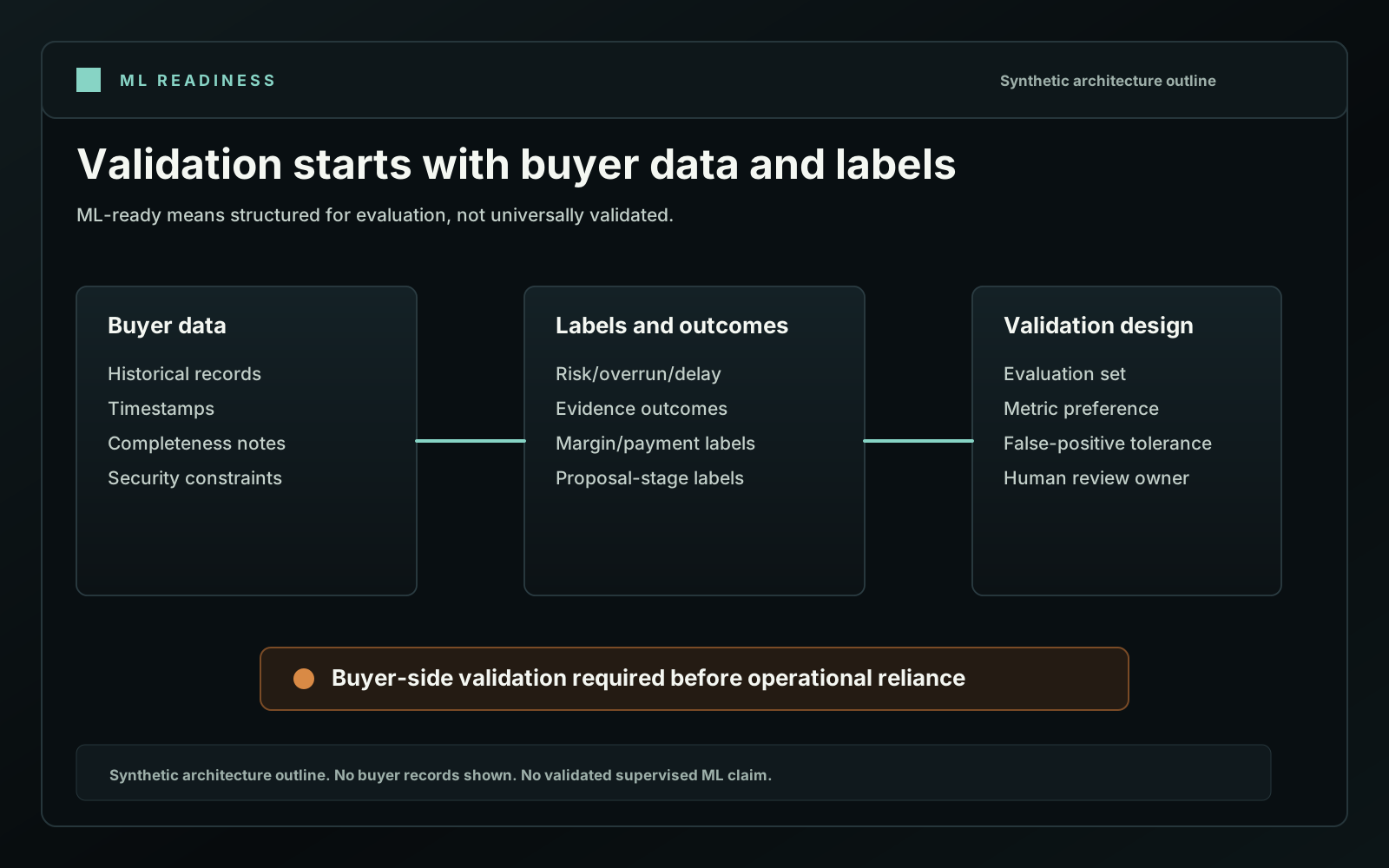
A visual map of readiness inputs.

The outline separates buyer data, labels and validation design before any candidate ML-assisted review is evaluated.

Synthetic-only architecture outline. No buyer records shown. ML readiness inputs, labels, evaluation design, validation review and human review ownership.
Synthetic-only architecture outline. No buyer records shown. Buyer-side validation required.

Readiness principles

Structured for evaluation, not validated or implemented by default.

  • ML-ready does not mean universally validated.
  • Claims Pro AI evaluation path is eval-only by default unless controlled v4 evidence confirms implementation_and_eval_present.
  • AI-augmented positioning requires controlled technical review.
  • Public site does not claim production validation.
  • Project Risk and Subcontractor Margin remain deterministic-first with tenant-specific ML upgrade paths.
  • Buyer data and labels are required before supervised or evaluated model claims can be considered.
  • Model performance depends on data quality, sampling, labels, workflow fit, evaluation design and failure handling.
  • Deterministic workflow logic and baseline rules should be reviewed before candidate ML patterns are scoped.
  • Buyer-side validation required before operational use.
  • No validated predictive ML accuracy claim and no guaranteed ROI.

Buyer inputs

Data, labels and evaluation design are required.

A candidate model pattern cannot be validated from public copy or synthetic previews.

  • Workflow question and human-owned decision boundary.
  • Required input objects, optional context and known missing fields.
  • Approved sample structures, labels or review outcomes where evaluation is proposed.
  • Data quality, permissions, sensitivity and retention expectations.
  • Evaluation design, acceptance thresholds and review-owner responsibilities.

Candidate ML patterns

Patterns that can be discussed after data assumptions are clear.

These are candidate ML-assisted patterns for review support. They do not create validated supervised ML, production deployment or autonomous decision claims.

Candidate pattern

Anomaly detection

Candidate pattern for surfacing records that differ from buyer-approved baselines, with transparent review notes and buyer-side validation required.

  • Risk signals
  • Evidence gaps
  • Margin exposure
  • Price anomalies
  • Offer comparability questions

Candidate pattern

Similarity search

Candidate pattern for comparing evidence, BOQ items, subcontract packages or tender offers after data permissions and evaluation rules are defined.

  • Evidence similarity
  • Package similarity
  • Item similarity
  • Offer similarity

Candidate pattern

Classification

Candidate pattern for assigning review categories when buyer data and labels exist; no validated supervised ML claim is made publicly.

  • Change-event classification candidate
  • Evidence category candidate
  • Tender exclusion or qualification detection candidate

Candidate pattern

Ranking

Candidate pattern for prioritizing review queues where the buyer validates scoring criteria, labels, thresholds and review outcomes.

  • Risk priority
  • Leakage exposure ranking
  • Missing-evidence priority
  • Comparability review priority

Candidate pattern

Embeddings/RAG

Candidate pattern for retrieval-assisted review of source references when permissions, citation behavior and governance boundaries are agreed.

  • Evidence retrieval
  • Contract-reference support
  • Review note grounding
  • Traceable source references

Candidate pattern

Lightweight forecasting

Candidate pattern for heuristic forecasting support only after buyer data, evaluation design and limits are agreed.

  • Schedule pressure context
  • Cost exposure context
  • Risk trend review
  • No validated predictive ML accuracy claim

Validation steps

Buyer-side validation comes before model reliance.

Use these steps to prepare a qualified technical review without implying current model performance.

Validation checklist

What a buyer should validate.

  • Confirm the buyer workflow question and the decision that remains human-owned.
  • Inventory required objects, optional objects, missing fields and sensitive-data exclusions.
  • Validate data quality, field semantics, status labels, timestamps, owners and permitted sample structures.
  • Define labels or review outcomes where supervised evaluation is being considered.
  • Choose candidate ML patterns only after deterministic workflow logic and baseline rules are clear.
  • Design evaluation sets, review metrics, acceptance thresholds, service-mode evaluation and failure handling with the buyer.
  • Review explainability, confidence/completeness scoring and audit trail expectations before operational use.
  • Document what is not claimed publicly: no validated predictive ML accuracy claim and no guaranteed ROI.

Public claim boundary

What cannot be claimed publicly.

The public site can describe ML-ready structure and candidate patterns, but these boundaries stay explicit.

Not claimed

No unsafe ML, production, ROI, legal or procurement claims.

  • No validated predictive ML accuracy claim.
  • No validated supervised ML claim.
  • No universal model validity across buyers or projects.
  • No production-ready or plug-and-play production deployment claim.
  • No guaranteed ROI, savings, claim recovery, margin improvement or commercial outcome.
  • No legal advice, claim-validity determination or legal entitlement assessment.
  • No accounting replacement, payment-processing guarantee or compliance certification.
  • No automatic award decisions or autonomous procurement decisions.
  • No customer proof, live client data, public source-code download, free sandbox or automatic marketplace access.

Related architecture

Readiness is only useful when governance, data quality and buyer validation responsibilities are clear.

Next step

Use ML readiness to prepare a technical review question.

Send the module, candidate pattern, available data objects, label assumptions, evaluation owner and governance boundary before deeper discussion.

Direct line

labs@nivorqa.com

Use email for review-pack requests, module fit questions, licensing conversations and pilot scoping.