Model governance

Traceable recommendations with human-in-the-loop review.

This page explains governance concepts for ML-assisted review: explainability, confidence/completeness scoring, usage logging, drift/evaluation and buyer-side validation without autonomous legal, procurement or accounting decisions.

Synthetic architecture outline

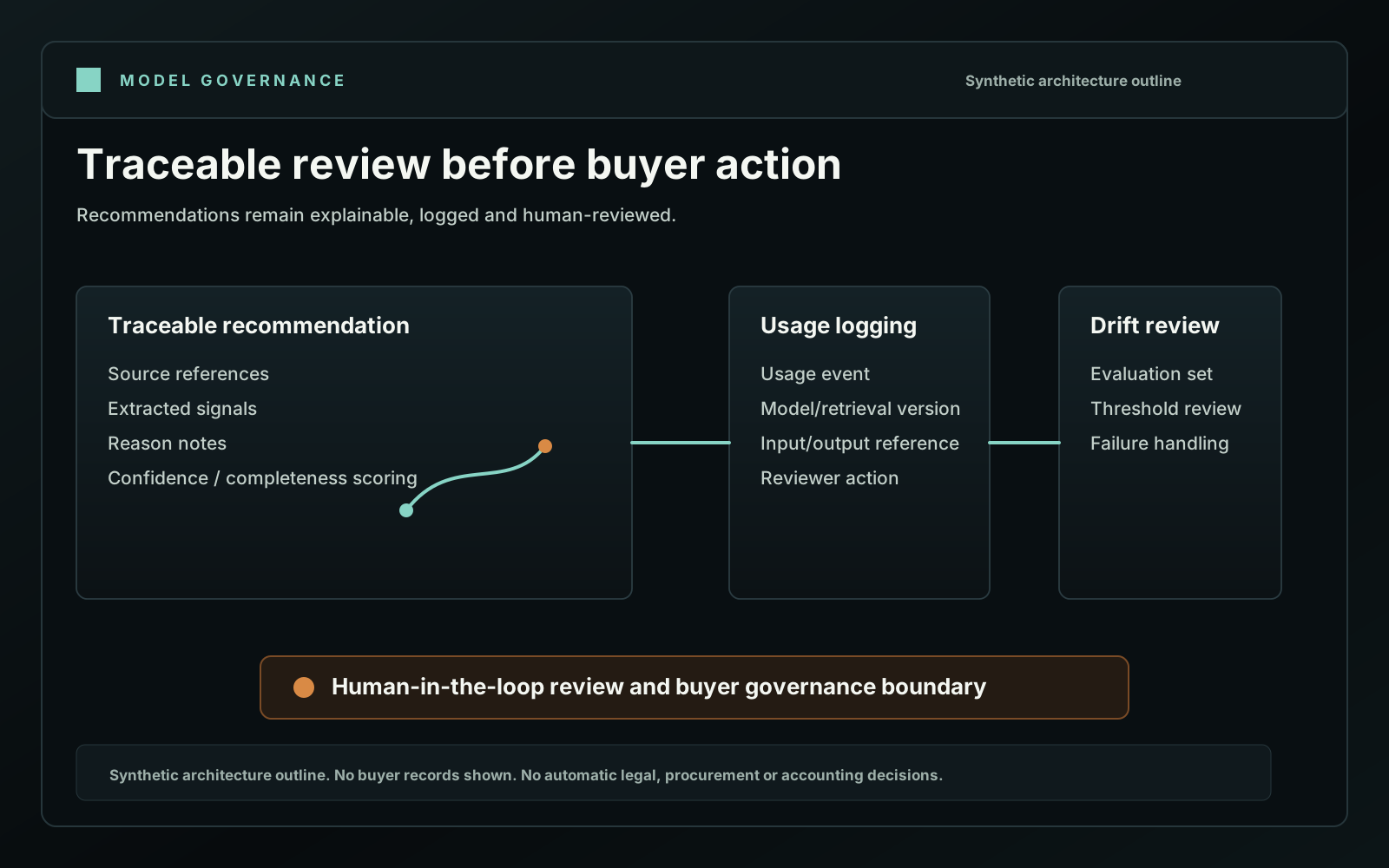
A visual map of governance controls.

The outline shows traceability, confidence/completeness scoring, usage logging, drift review and human-in-the-loop ownership.

Synthetic-only architecture outline. No buyer records shown. Traceable recommendations, confidence and completeness scoring, model usage logging, drift evaluation and human-in-the-loop review.
Synthetic-only architecture outline. No buyer records shown. No automatic legal, procurement or accounting decisions.

Governance summary

Recommendations must stay traceable and reviewable.

  • Human-in-the-loop review stays central across all module intelligence examples.
  • AI evidence status separates implementation-present AI evidence, eval-only AI evidence, deterministic ML upgrade path and proposal-stage intelligence outline.
  • Claims Pro AI evaluation path is evidence-gated until controlled technical review confirms implementation status.
  • Traceable recommendations should show source fields, extracted signals, reason notes and review state.
  • Confidence/completeness scoring can prioritize review, but buyer-side validation required before operational use.
  • Model usage logging is a governance concept for qualified review, not a public production claim.
  • Drift/evaluation review should be defined when buyer data, labels, workflow rules or source systems change.
  • No automatic legal, procurement or accounting decisions and no guaranteed outcomes.

Decision boundary

Buyer governance owns final action.

  • No legal advice or claim-validity determination.
  • No automatic award decisions or autonomous procurement decisions.
  • No accounting replacement or payment-processing guarantee.
  • No compliance certification.
  • No guaranteed outcomes.
  • No guaranteed ROI, savings, claim recovery, margin improvement or tender outcome.
  • Buyer-side validation required and human-in-the-loop review required.

Governance concepts

Concepts to review before model-assisted workflow use.

These are architecture and diligence concepts. They do not create production-readiness, compliance, ROI or model-performance claims.

Governance concept

Human-in-the-loop review

Workflow outputs should route attention to qualified buyer reviewers; final decisions remain with the buyer.

  • Named reviewer
  • Review state
  • Escalation owner
  • Human decision record

Governance concept

Traceable recommendations

Recommendations should show the source fields, extracted signals, deterministic rules and candidate model context that influenced the review item.

  • Source references
  • Reason codes
  • Review notes
  • Audit trail records

Governance concept

Confidence/completeness scoring

Confidence and completeness scores can help prioritize review, but they require buyer-side validation and should not force outcomes.

  • Data completeness scoring
  • Missing-evidence signals
  • Confidence labels
  • Review priority

Governance concept

Model usage logging concept

Where a model-assisted pattern is used, the buyer review design should log usage, version, prompt/retrieval context where applicable and reviewer action.

  • Usage event
  • Model or retrieval version
  • Input/output reference
  • Reviewer action

Governance concept

Drift/evaluation concept

Buyer teams should define periodic evaluation and drift review when data distributions, labels, workflow rules or source systems change.

  • Evaluation set
  • Drift review
  • Threshold review
  • Failure handling

Governance concept

Governance boundary

The public site describes governance concepts only; no automatic legal, procurement or accounting decisions and no guaranteed outcomes are claimed.

  • Buyer-side validation required
  • Human review required
  • No automatic award decisions
  • No guaranteed ROI

Safe public language

The governance boundary stays visible.

These public boundaries apply to model-assisted review, module pages, architecture pages and buyer-review discussions.

Public boundaries

No unsafe model or outcome claims.

  • ML-ready means structured for future evaluation; it does not mean universally validated.
  • ML-assisted means review support; it does not mean autonomous decision-making.
  • Claims Pro AI evaluation path is evidence-gated until implementation and service-mode evaluation evidence are confirmed in controlled technical review.
  • AI-augmented positioning requires controlled technical review.
  • Public site does not claim production validation or public production model performance.
  • Eval harness language refers to methodology validation of schema, metrics, gates and governance; it does not prove live model accuracy.
  • Service-mode evaluation available during controlled technical review after a provider/model is configured.
  • AI is additive, feature-flagged and human-verified where it is enabled.
  • Buyer-side validation required for data quality, labels, workflow fit, evaluation design and governance.
  • Human-in-the-loop review remains required before buyer action.
  • No validated predictive ML accuracy claim.
  • No validated supervised ML claim.
  • No guaranteed ROI, savings, claim recovery, margin improvement or outcome.
  • No legal advice, claim-validity determination, accounting replacement, payment-processing guarantee, compliance certification or automatic award decisions.
  • No production-readiness guarantee, plug-and-play production deployment, public source-code download, free sandbox, automatic marketplace access, customer proof or live client data.

Related architecture

Governance questions should be tied to a module, data objects, candidate ML pattern and buyer review owner.

Next step

Bring governance questions into qualified review.

Send the module, candidate pattern, review owner, traceability need, logging expectation and buyer validation boundary before deeper discussion.

Direct line

labs@nivorqa.com

Use email for review-pack requests, module fit questions, licensing conversations and pilot scoping.